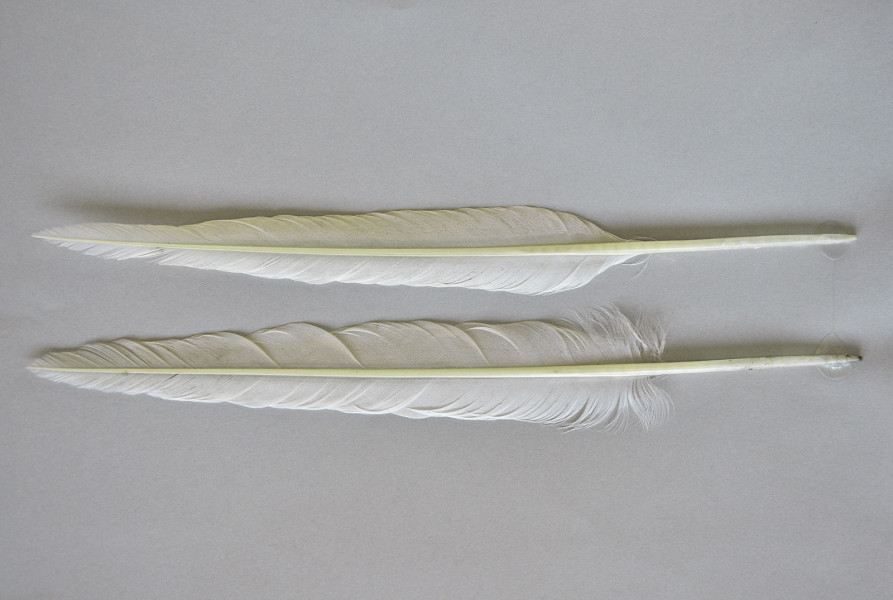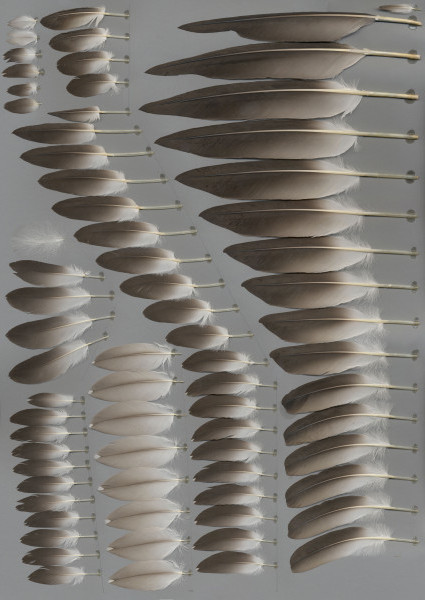
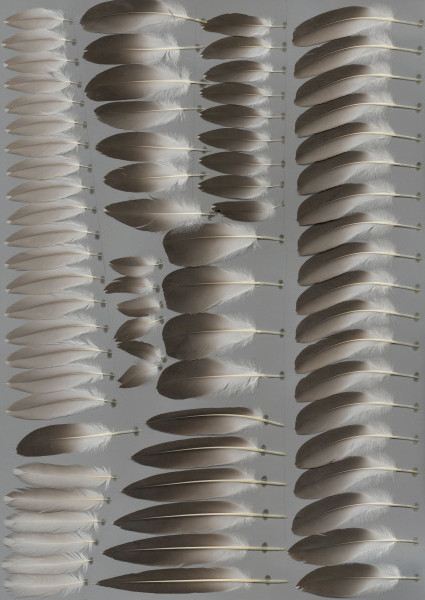

Der Basstölpel besitzt keinen ausgeprägten Geschlechtsdimorphismus. Wohl aber zeigen sich deutliche Unterschiede im Gefieder von Vögeln unterschiedlichen Alters. Das adulte Gefieder wird nach vier Jahren erreicht und ist größtenteils rein weiß gefärbt. Die Handschwingen sind für ihre Breite relativ kurz und zeigen so mehr Ähnlichkeiten mit Vögel wie Tordalk als mit denen von Enten oder Möwen. Im adulten Gefieder sind die Handschwingen dunkelbraun gefärbt mit einem großflächigen hellgrauen Innenfahnensaum. Die Außenfahne ist nur sehr schwach verengt. Die Innenfahne zeigt vorallem auf den äußeren zwei bis drei Handschwingen eine deutliche Verengung. Auch dieser Federaufbau ist nicht weit verbreitet. Die Armschwingen sind rein weiß gefärbt mit einem leichten dunklen Saum um den Kiel. Den Übergang bilden nur ein bis zwei Federn in denen der Flügel vom Dunkelgrau ins Weiß wechselt. Die Steuerfedern sind ebenfalls rein weiß gefärbt. Die S1 ist verlängert und besitzt eine dolchförmige Gestalt.
Das Jugendgefieder ist relativ gleichmäßig gefärbt. Die Hand- und Armschwingen sind dunkelbraun mit einem graubraunen Saum der Innenfahne. Die Handschwingen sind nicht anders gefärbt. Auch die Steuerfedern besitzen diese braune Färbung mit dem hellen Saum. Im Lauf der Jahre nimmt das Gefieder immer mehr an Kontrast und Weißanteil zu (ähnlich wie bei den Großmöwen der Gattung Larus).
| plume | nombre | plus longue |
|---|---|---|
| rémige primaire | 10 par aile | Aucune donnée disponible |
| rémige secondaire | 25-27 par aile |
approx. 160.0mm
n=1 S1 (100%) |
| rectrice |
12
|
approx. 230.0mm
n=1 R1 (100%) |
|
do_not_translate_yet:measurements_remarks.title
do_not_translate_yet:measurements_remarks.number_of_individuals ndo_not_translate_yet:measurements_remarks.selection_of_individuals do_not_translate_yet:measurements_remarks.method_titledo_not_translate_yet:measurements_remarks.method do_not_translate_yet:measurements_remarks.percentage_titledo_not_translate_yet:measurements_remarks.percentage |
||