
menu

Seebohm
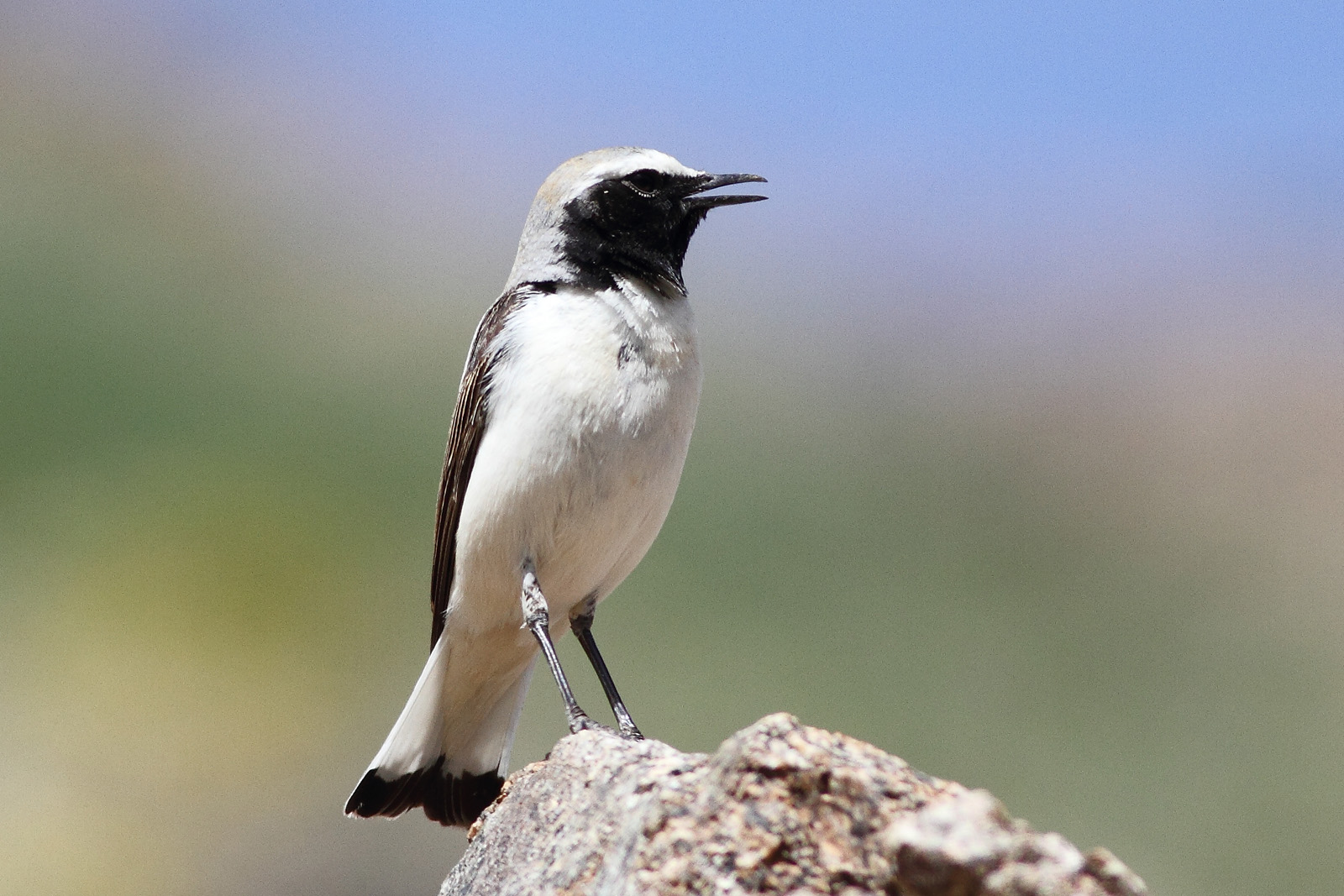
Oenanthe seebohmi
species of Muscicapidae


© Thomas Hochebner
ad. male
1st cy

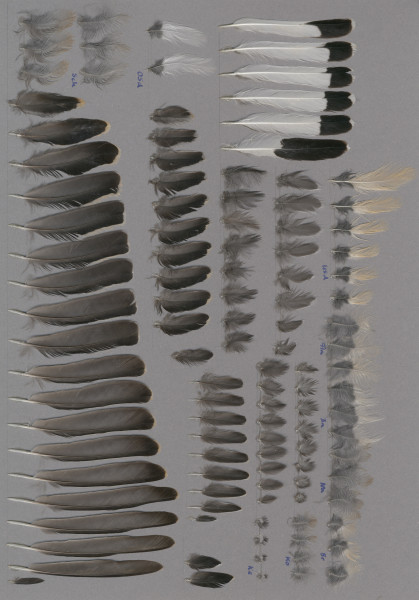
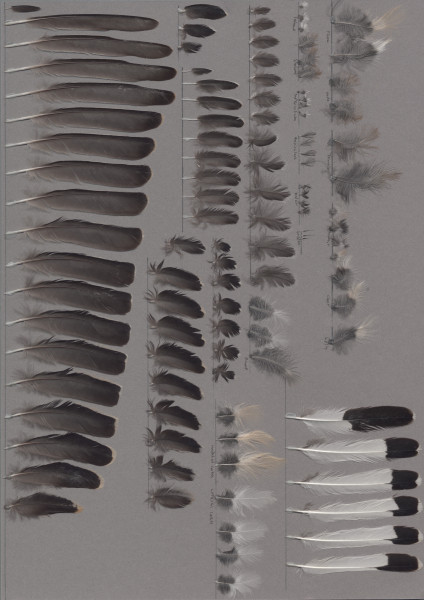
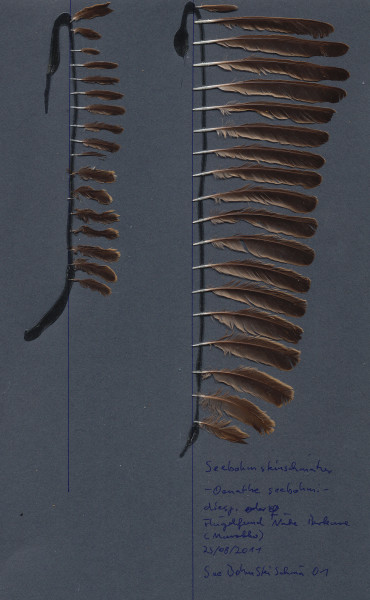
Das adulte Männchen des Seebohm-Steinschmätzers besitzt relativ dunkle, schwarzbraune Hand- und Armschwingen. Im Verlauf der Abnutzung des Gefieders können sich diese Federn ins dunkelbraune ausbleichen. Die Spitzen der Hand- und Armschwingen sind deutlich sandfarben bis cremeweiß gerandet. Die Außenfahnen der Schwingen besitzen eine ebenso gefärbte feine Kontur, welche sich jedoch auch abnutzt. Die Rückenfedern sind kräftig mittelgrau gefärbt und bilden einen hohen Kontrast zum Flügel.

Die Steuerfedern sind größtenteils weiß gefärbt mit der für Steinschmätzer typischen schwarzen Endbinde. Im Vergleich zum Steinschmätzer exisieren keine nennenswerten Unterschiede.

Durch die sehr nahe Verwandtschaft zum Steinschmätzer ist es sehr wahrscheinlich, dass die Weibchen auch etwas blasser braun gezeichnet sind.

feather number longest
primary 10 per wing approx. 85.5mm n=1
P7 (100%)
secondary 9 per wing approx. 65.0mm n=1
S1 (100%)
retrix 12
approx. 68.5mm n=1
R4 (100%)
Annotations for measurement data

number of individuals n

For the statistics of the longest feather measurements, we only use data from birds having the largest feathers present. A broken, missing or growing feather, which could potentially be the longest, disqualifies the individual for measurement. Likewise, no hybrids are included in the statistics. However, birds of different ages (e.g. young and adult woodpeckers), sexes (e.g. male and female sparrowhawks) and subspecies are used equally in the diagram and can therefore lead to a very wide range of variation. The greater the number of individuals measured, the more accurate the range of variation. Very small data sets of one or only a few birds only lead to approximate results.

measurement method

The feathers are measured digitally via the scan. A ventral curvature of the feathers is straightened for the measurement, but a caudal curvature is not! Measurements are taken from the start of the calamus to the largest extension of the feather. This does not always have to be the rachis, but can also be the vanes (e.g. in the case of buntings). Special features, such as the wax platelets on the waxwing, are omitted from the measurement.

percentages

The percentages of the individual feathers, e.g. P5, indicate the proportion of individuals in which this feather is the longest of its kind. This information should always be considered in conjunction with the total number of birds measured. An indication of 100% for five individuals is no guarantee that this feather is really always the longest.

country allocations

extant

Algeria · Mauritania · Morocco · Senegal · Tunisia ·
source: IUCN 2025. IUCN Red List of Threatened Species. Version 2025-1 <www.iucnredlist.org>
assessment data: |

Songbirds and kin

conservation status

  • CITES
    not listed
  • Regulation (EG) Nr. 865/2006
    not listed
  • German Federal Nature Conservation Act §44
    not listed