


menu

Black Wheatear
Oenanthe leucura
species of Muscicapidae

juv. male
ad.
juv.

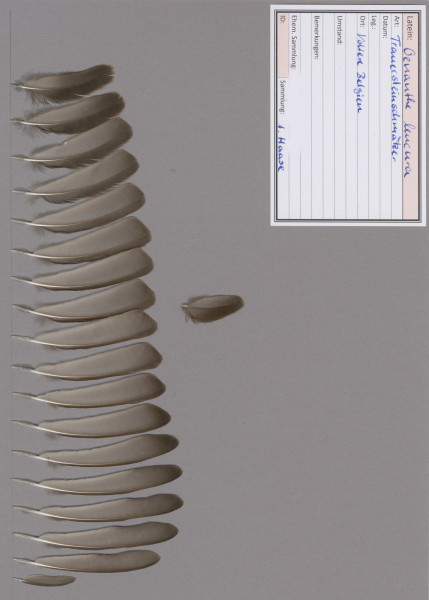
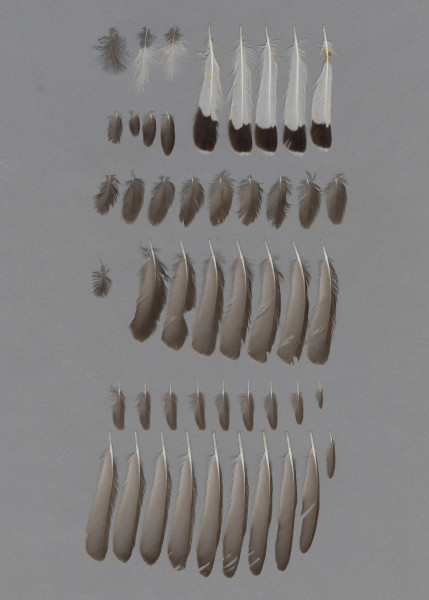
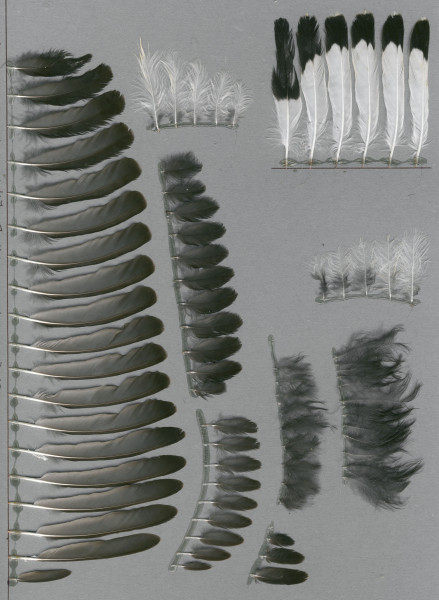
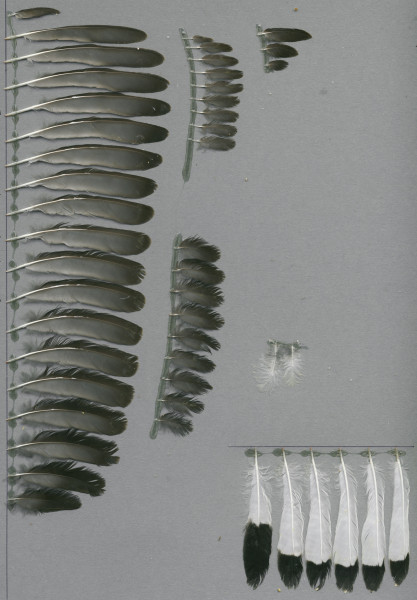
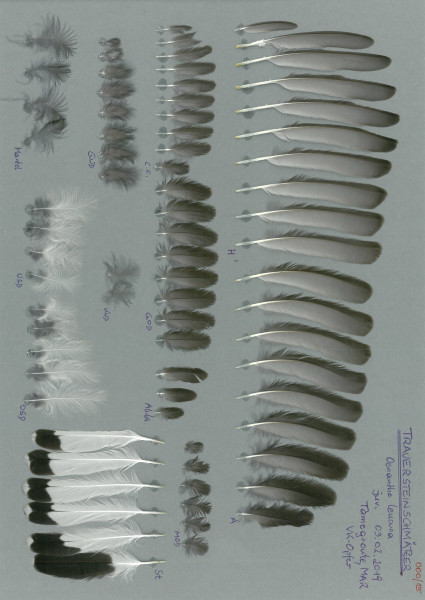
Der Trauersteinschmätzer besitzt seinen Namen durch das beste Unterscheidungsmerkmal von anderen Steinschmätzern: Sein gleichmäßig anthrazit gefärbtes Federkleid. Lediglich die Steuerfedern erinnern an andere Steinschmätzer. Er ist jedoch auch deutlich größer als sein Verwandter der Steinschmätzer.

Die Hand- und Armschwingen sind relativ gleichmäßig schwarzgrau gefärbt. Die für Steinschmätzer typische Außenfahnenkontur fehlt bis auf eine leichte Aufhellung der Spitzen der Armschwingen. Der obere Teil der Federn und die Schirmfedern sind abgedunkelt. Die H10 ist über ein Drittel so lang wie die H9. Die H5-H8 besitzen eine Verengung der Außenfahne (beim Steinschmätzer (Oenanthe oenanthe) lediglich H6-H8).

Das Steuer des Trauersteinschmätzers besitzt einen etwas größeren Weißanteil als der Steinschmätzer. Durch die zu einem größeren Teil schwarz gefärbte S1 entstehen im Steuer zwei weiße Flächen, welche der sonst sehr trist gefärbte Vogel gern zur Schau stellt. Die Spitze der Steuerfedern ist oft weiß oder hellgrau, manchmal auch hell graubraun gesäumt.

number longest
primary 10 per wing 81.0 - 82.0mm n=3
P6 (67%) P7=P6 (33%)
secondary 9 per wing 68.5 - 69.0mm n=5
S1 (60%) S1=S2 (20%) S2 (20%)
retrix 12
71.5 - 73.0mm n=2
R4 (50%) R4=R5 (50%)
wing length1 hand-wing-index1,2 (HWI) primaries-index wing length/longest primary ratio hand-wing-index/primaries-index ratio
89 - 105mm n=16 19 - 24% n=16 15 - 16% n=3 no data available no data available
detailed information

The wing length is measured on the flattened and straightened wing ("maximum chord") from the carpal joint to the tip of the longest primary feather, the so-called "Kleinschmidt-method".

combined data from:
Avonet1: 89 - 105mm n=16

The hand-wing-index, introduced by Kipp 1959, is calculated as the ratio of the hand length (difference between the length of the longest primary and the first secondary) to the wing length.

combined data from:
Avonet1: 19 - 24% n=16,
The primaries-index is calculated as the ratio of the longest primary feather length to the first (outermost) secondary. It is the equivalent of the hand-wing index for feather measurements. The wing length/longest primary ratio is calculated as the ratio of the wing length to the length of the longest primary feather. The hand-wing-index/primaries-index ratio is calculated as the ratio of the hand-wing index to the primaries-index.
1 Tobias, J. A., et al. (2022). AVONET: morphological, ecological and geographical data for all birds.
2 Kipp, Friedrich A.: "Der Handflügel-Index als flugbiologisches Maß", erschienen in "Vogelwarte - Zeitschrift für Vogelkunde", 1959, Band 20, Heft 1


1st cy

country allocations

extant

Algeria · Bulgaria (vagrant) · Greece (vagrant) · Israel (vagrant) · Italy (vagrant) · Libya · Liechtenstein (vagrant) · Malta (vagrant) · Mauritania (vagrant) · Montenegro (vagrant) · Morocco · Norway (vagrant) · Portugal · Serbia (vagrant) · Spain · Tunisia · Western Sahara ·

extinct post-1500

Gibraltar ·

possibly extinct

France ·
source: IUCN 2025. IUCN Red List of Threatened Species. Version 2025-1 <www.iucnredlist.org>
assessment data: |

Songbirds and kin

distribution

conservation status

  • CITES
    not listed
  • Regulation (EG) Nr. 865/2006
    not listed
  • German Federal Nature Conservation Act §44
    protected