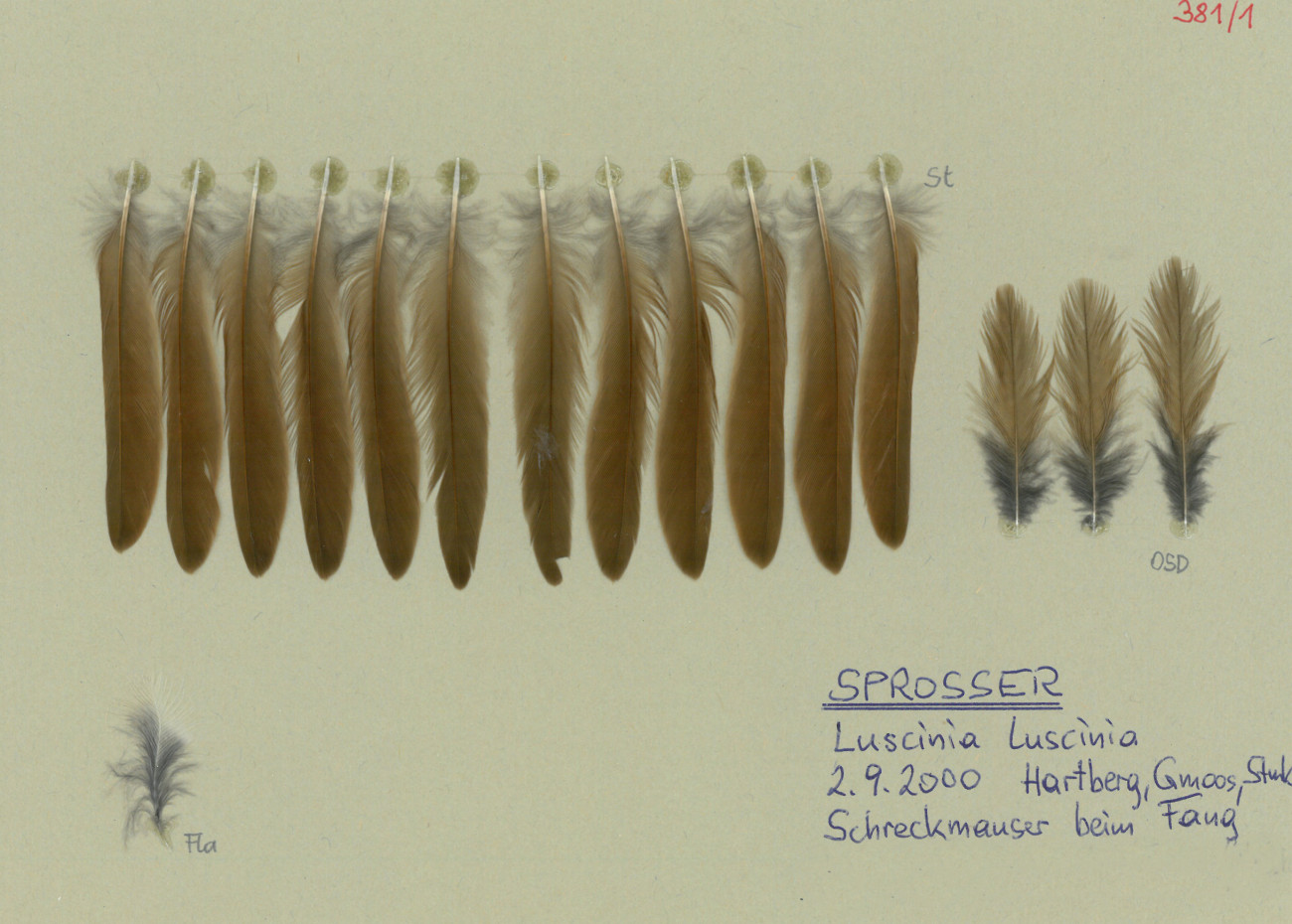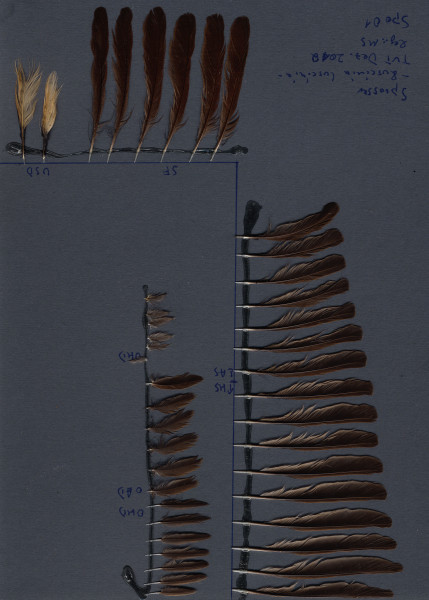
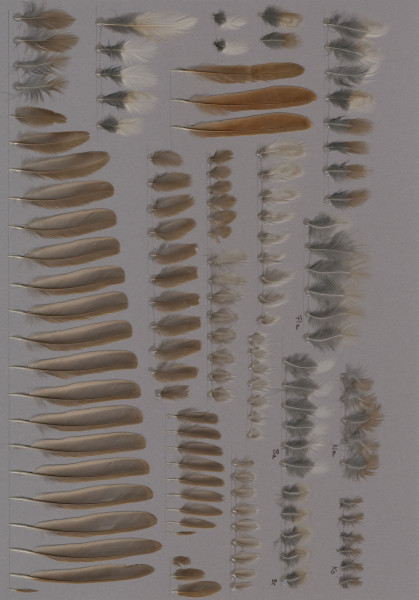

Die Handschwingen sind mittel-graubraun gefärbt mit einer leichten Aufhellung der Innenfahne. Die Außenfahne ist erdbraun gefärbt. Die Steuerfedern sind etwas rötlicher braun gefärbt. Die OSd besitzen die gleiche Färbung. Die USd sind weiß bis gräulich mit einer feinen braunen Querbänderung (kann auf einzelnen USd fehlen).
Die Arten Nachtigall (Luscinia megarhynchos) und dem Gattungsnominativ Sprosser (Luscinia luscinia) sind sich in einigen Merkmalen recht ähnlich, können jedoch bei ausreichend vorhandenen Federn klar voneinander unterschieden werden. Der Sprosser ist meist um einiges größer. Der Überschneidungsbereich der längsten Handschwinge liegt bei ca. 71-74mm. Die längste Handschwinge einer Nachtigall ist so gut wie nie länger, die eines Sprosser nie kürzer. Die Schirmfedern des Sprossers sind vergrößert. Von der A6 zur A7 entsteht oft eine deutliche Kante. Der Flügel der Nachtigall ist etwas gleichmäßiger geformt. Die H10 der Nachtigall besitzt ungefähr 1/3 der Länge der H9 und H8 und H7 sind meist ungefähr gleich lang. Die H10 des Sprossers misst meist weniger als 1/4 der H9 und die H7 ist kürzer als die H8 und die H7 ist ungefähr so lang wie die H9. Der Sprosser ist im Gefieder insgesamt etwas dunkler und bis auf Ausnahmen auch weniger rötlich.
| feather | number | longest |
|---|---|---|
| primary | 10 per wing |
75.0 - 80.5mm
n=2 P8 (100%) |
| secondary | 9 per wing |
61.0 - 63.0mm
n=2 S1 (100%) |
| retrix |
12
|
69.5 - 74.5mm
n=2 R3 (50%) R1 (50%) |
|
do_not_translate_yet:measurements_remarks.title
do_not_translate_yet:measurements_remarks.number_of_individuals ndo_not_translate_yet:measurements_remarks.selection_of_individuals do_not_translate_yet:measurements_remarks.method_titledo_not_translate_yet:measurements_remarks.method do_not_translate_yet:measurements_remarks.percentage_titledo_not_translate_yet:measurements_remarks.percentage |
||