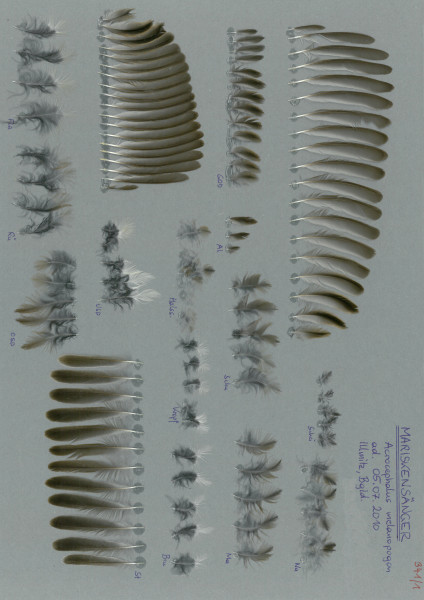
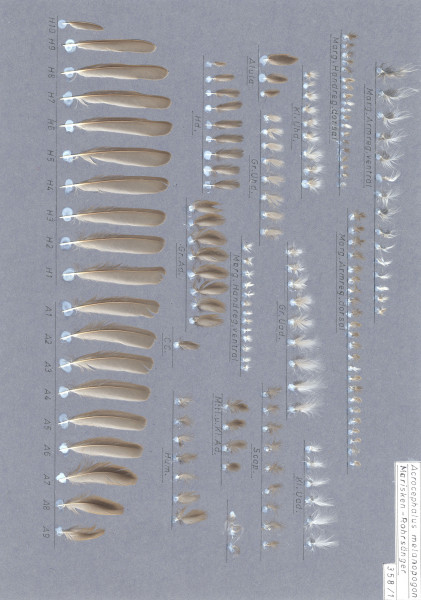


Die Hand- und Armschwingen sind graubraun mit warmbrauner Außenfahne. Die Innenfahne ist weißlich aufgehellt. Die Außenfahnen der Handschwingen H6-H8 sind im oberen Teil verengt. Die Längste Handschwinge ist die H6 oder die H7 (manchmal beide gleich lang). Diese beiden Merkmale lassen den Mariskenrohrsänger anhand des Schwingendiagramms sicher vom Schilfrohrsänger unterscheiden. Die äußeren Armschwingen sind gefärbt wie die Handschwingen. Die Schirmfedern sind ähnlich denen des Schilfrohrsängers, kräftig abgedunkelt, mit einer cremefarbenen Säumung der Ränder. Die Aufhellung der Innenfahne ist jedoch stärker und flächiger.
Die Steuerfedern sind dunkelbraun gefärbt und so deutlich dunkler und auch gleichmäßiger gefärbt als die des Schilfrohrsängers. Farblich erinnern sie eher an den Feldschwirl, wenn auch die Abstufung nach außen nicht so stark ist und die Steuerfedern etwas schmaler sind (dennoch breiter als beim Schilfrohrsänger). Die S1 ist die längste Steuerfeder, alle weiteren verkürzen sich nach außen. Die äußeren Steuerfedern zeigen eine hellere Grundfärbung und eine feine, weißbraune Außen- und Innenfahnenkontur. Die OSd sind cremefarben bis fast rein weiß und in Relation zu den Steuerfedern recht lang. Sie besitzen jedoch keinen dunklen Schaftstrich wie Schwirle.
| feather | number | longest |
|---|---|---|
| primary | 10 per wing |
52.0 - 56.5mm
n=2 P6 (100%) |
| secondary | 9 per wing |
46.5 - 49.0mm
n=2 S1 (100%) |
| retrix |
12
|
approx. 49.0mm
n=1 R2 (100%) |
|
do_not_translate_yet:measurements_remarks.title
do_not_translate_yet:measurements_remarks.number_of_individuals ndo_not_translate_yet:measurements_remarks.selection_of_individuals do_not_translate_yet:measurements_remarks.method_titledo_not_translate_yet:measurements_remarks.method do_not_translate_yet:measurements_remarks.percentage_titledo_not_translate_yet:measurements_remarks.percentage |
||