
Menu

Monticole bleu
Monticola solitarius
espèce des Muscicapidae

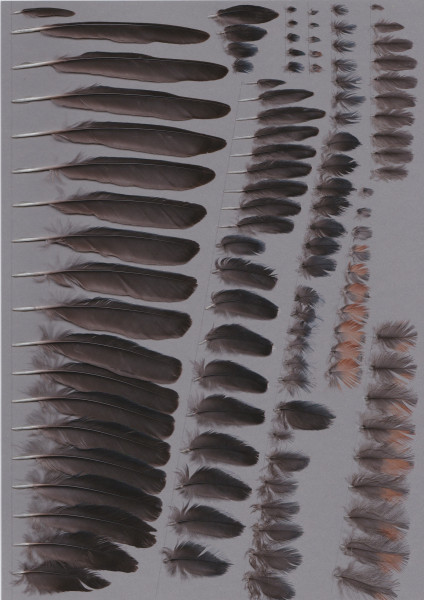
ad. Femelle
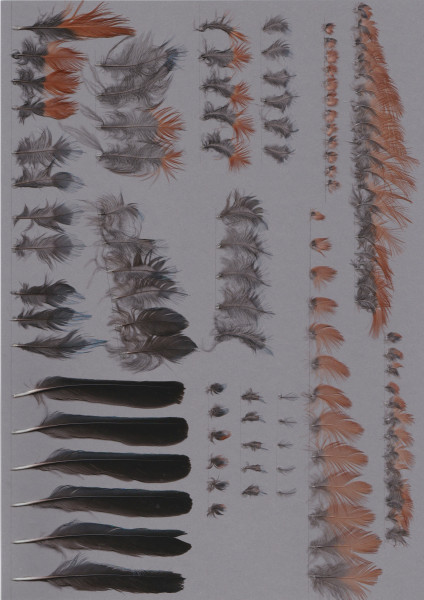
Mâle
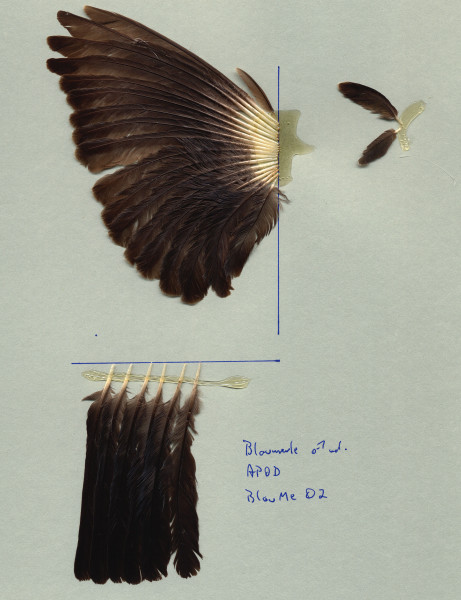
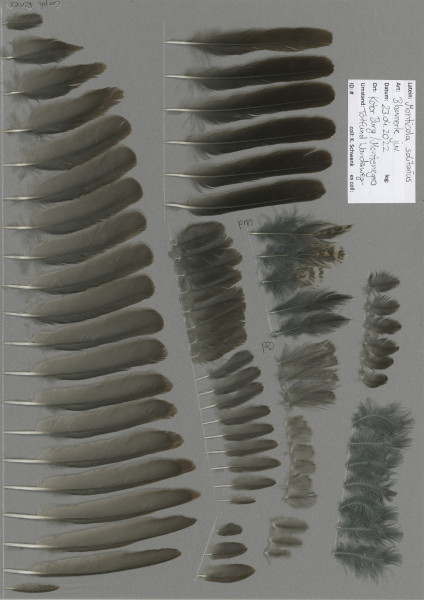
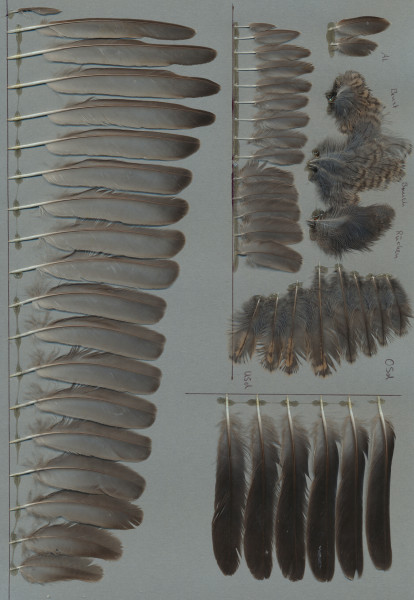
Die weibliche Blaumerle ähnelt im Gefieder sehr der Amsel und dem Star. Die Verengungen der Handschwingungen sind jedoch völlig anders. Der Star besitzt nur eine geringfügige Verengung der H8 und 9, die Amsel in den H5-9. Die Blaumerle zeigt Verengungen in den H6-9, jedoch keine in H5. Auch sind die Schirmfedern im Vergleich zur Amsel nicht so stark abgedunkelt. Die S6 ist weniger stark gebogen. Insgesamt ist sie etwas kleiner.
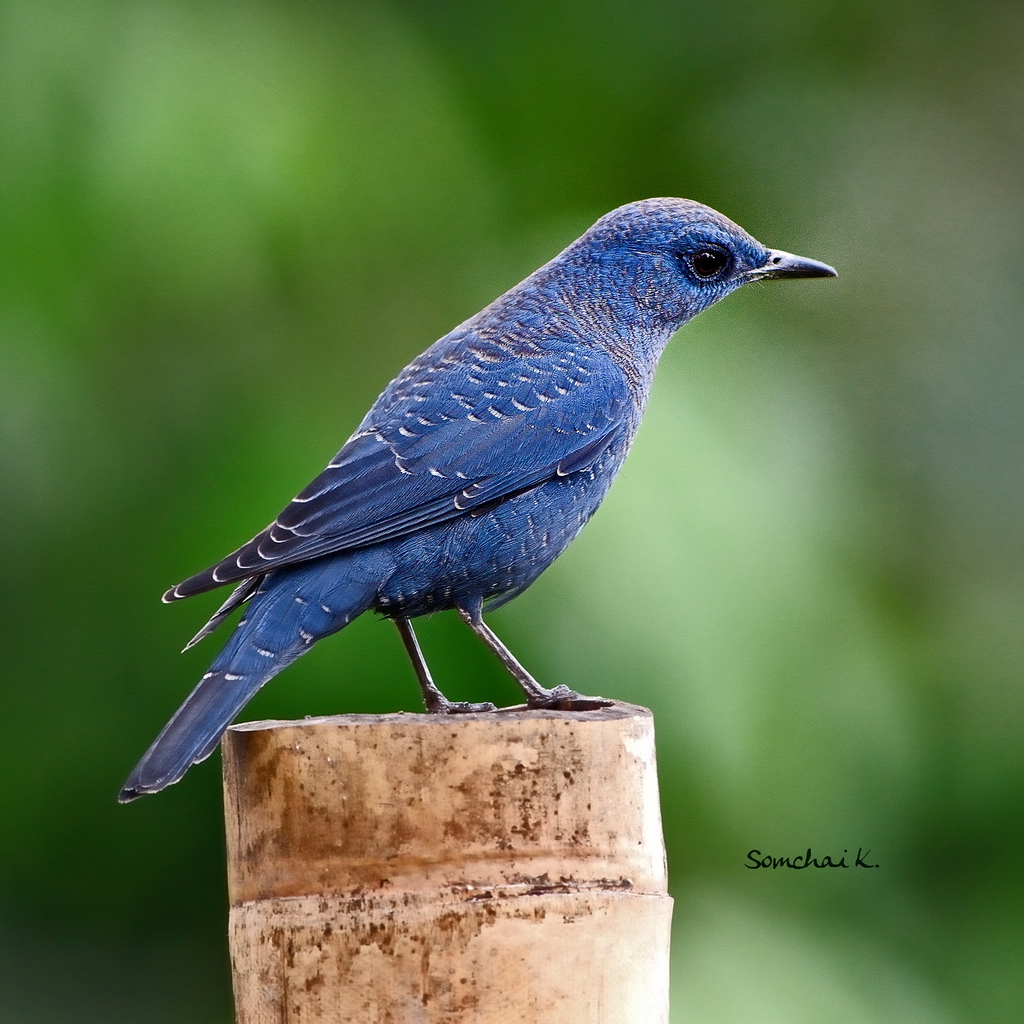
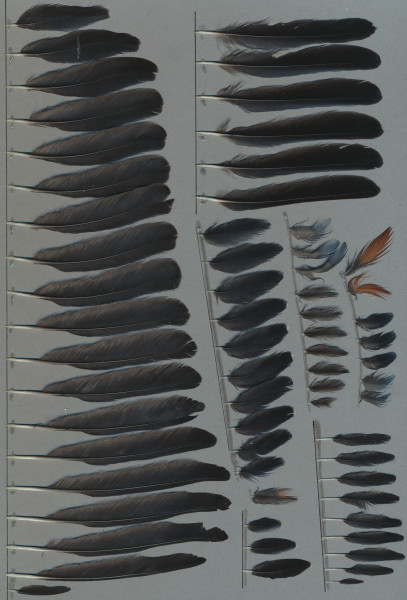
Die Männchen lassen sich durch ihr dunkelblaues Federkleid leicht identifizieren. Juvenile Blaumerlen ähneln sehr den Weibchen, unterscheiden sich jedoch durch die deutlichen, weißbraunen Spitzensäume der GrHd. Weibliche Blaumerlen lassen sich von weiblichen Steinröteln insbesondere durch die deutlich längere H10 und das andere Flügeldiagramm zu unterscheiden, in dem die H7 meist längste Handschwinge ist und H6-H8 im oberen Teil verengt sind.
plume nombre plus longue
rémige primaire 10 par aile 98.0 - 111.0mm n=7
P7 (86%) P8 (14%)
rémige secondaire 9 par aile 76.5 - 86.5mm n=7
S1 (100%)
rectrice 12
85.0 - 98.5mm n=7
R3 (71%) R4 (14%) R2 (14%)
Annotations for measurement data

number of individuals n

For the statistics of the longest feather measurements, we only use data from birds having the largest feathers present. A broken, missing or growing feather, which could potentially be the longest, disqualifies the individual for measurement. Likewise, no hybrids are included in the statistics. However, birds of different ages (e.g. young and adult woodpeckers), sexes (e.g. male and female sparrowhawks) and subspecies are used equally in the diagram and can therefore lead to a very wide range of variation. The greater the number of individuals measured, the more accurate the range of variation. Very small data sets of one or only a few birds only lead to approximate results.

measurement method

The feathers are measured digitally via the scan. A ventral curvature of the feathers is straightened for the measurement, but a caudal curvature is not! Measurements are taken from the start of the calamus to the largest extension of the feather. This does not always have to be the rachis, but can also be the vanes (e.g. in the case of buntings). Special features, such as the wax platelets on the waxwing, are omitted from the measurement.

percentages

The percentages of the individual feathers, e.g. P5, indicate the proportion of individuals in which this feather is the longest of its kind. This information should always be considered in conjunction with the total number of birds measured. An indication of 100% for five individuals is no guarantee that this feather is really always the longest.

immat. Mâle
ad. Mâle
ad. Femelle
Galerie des spécimens

Allocations nationales

extant

Afghanistan · Albania · Algeria · Andorra · Armenia · Australia (vagrant) · Azerbaijan · Bahrain · Belgium (vagrant) · Bhutan · Bosnia and Herzegovina · Brunei Darussalam · Bulgaria · Cambodia · Cameroon · Canada (vagrant) · Chad · China · Côte d'Ivoire (vagrant) · Croatia · Cyprus · Djibouti · Egypt · Eritrea · Ethiopia · France · Gambia · Georgia · Germany (vagrant) · Ghana · Gibraltar · Greece · Guinea · Hong Kong · India · Indonesia · Iran, Islamic Republic of · Iraq · Israel · Italy · Japan · Jordan · Kazakhstan · Korea, Democratic People's Republic of · Korea, Republic of · Kuwait · Kyrgyzstan · Lao People's Democratic Republic · Lebanon · Liberia · Libya · Macao · Malaysia · Mali (vagrant) · Malta · Mauritania · Monaco · Montenegro · Morocco · Myanmar · Nepal · Niger · Nigeria · North Macedonia · Oman · Pakistan · Palau (vagrant) · Palestine, State of · Philippines · Portugal · Qatar · Russian Federation · San Marino · Saudi Arabia · Senegal · Serbia · Sierra Leone · Singapore · Slovakia (vagrant) · Slovenia · Somalia · Spain · Sri Lanka · Sudan · Sweden (vagrant) · Switzerland · Syrian Arab Republic · Taiwan, Province of China · Tajikistan · Thailand · Tunisia · Türkiye · Turkmenistan · United Arab Emirates · United Kingdom of Great Britain and Northern Ireland (vagrant) · Uzbekistan · Viet Nam · Yemen ·
source: IUCN 2025. IUCN Red List of Threatened Species. Version 2025-1 <www.iucnredlist.org>
assessment data: |

Songbirds and kin

Statut de conservation

  • CITES
    non listé
  • Règlement (CE) n o 865/2006
    non listé
  • Loi fédérale allemande sur la conservation de la nature (FNCA) §44
    Protégé