

Menú

Guion de codornices
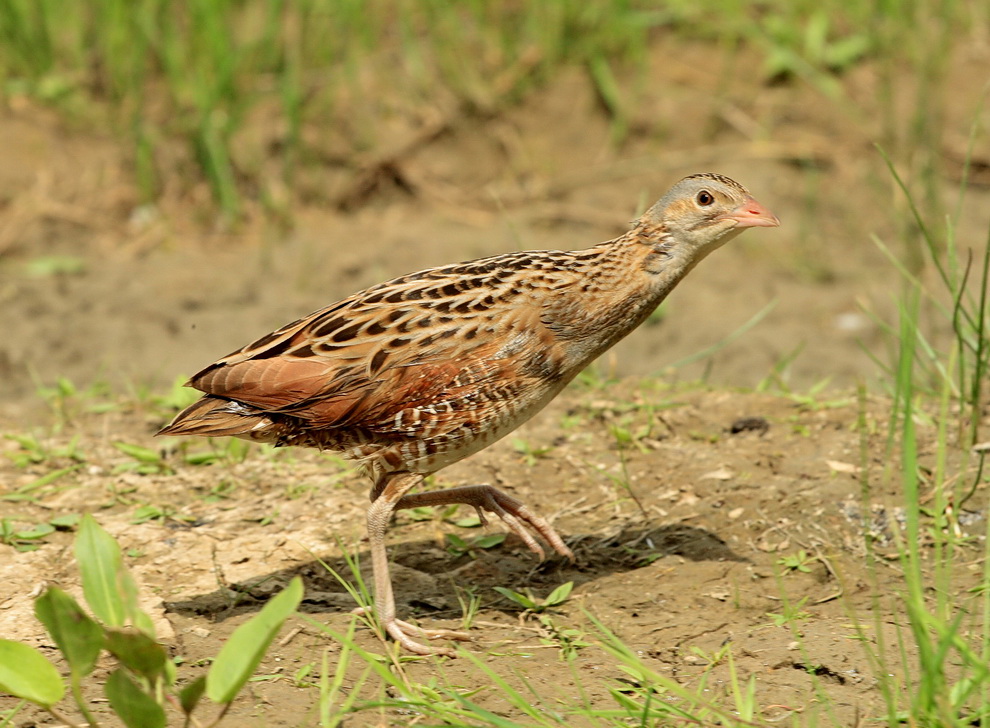
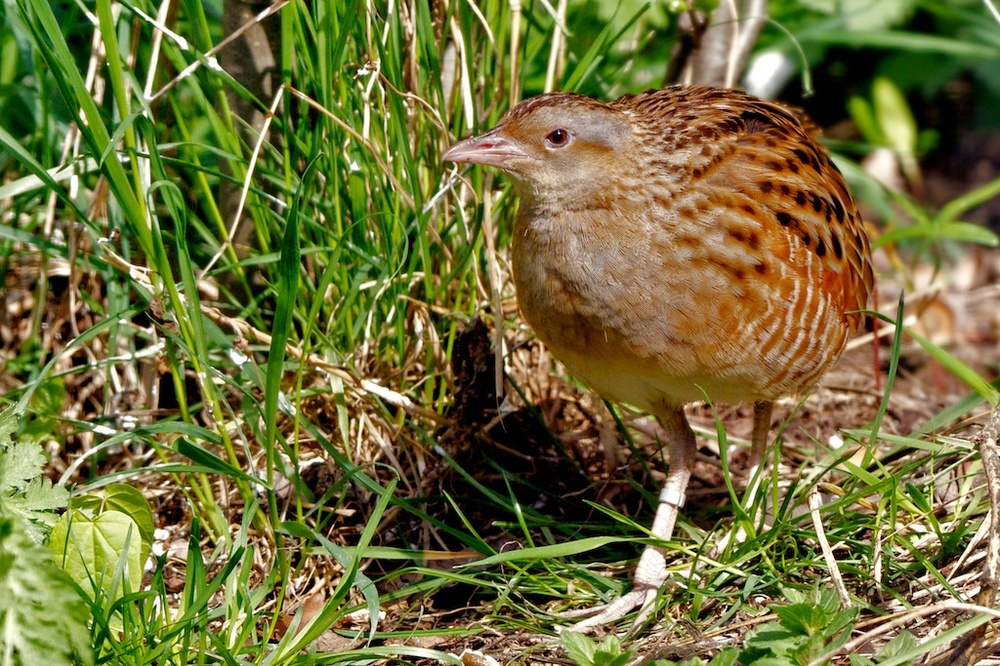
Crex crex
Especie de Rallidae

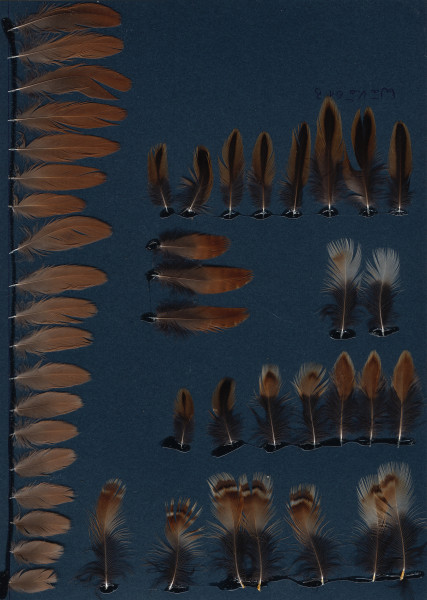
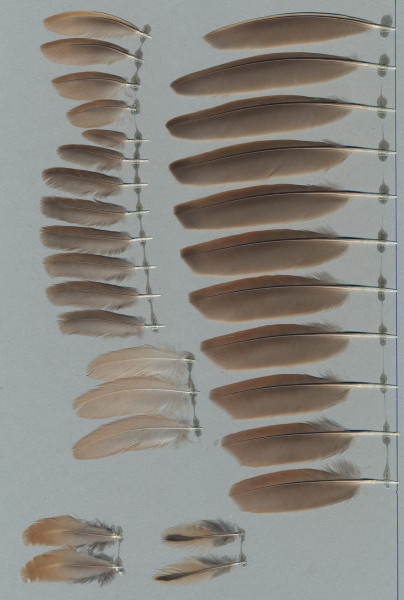
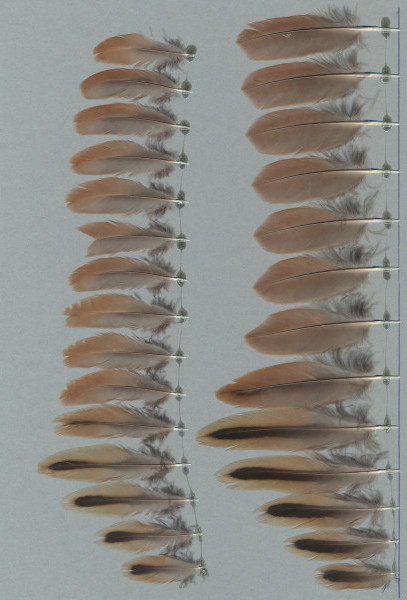
Juv. Macho

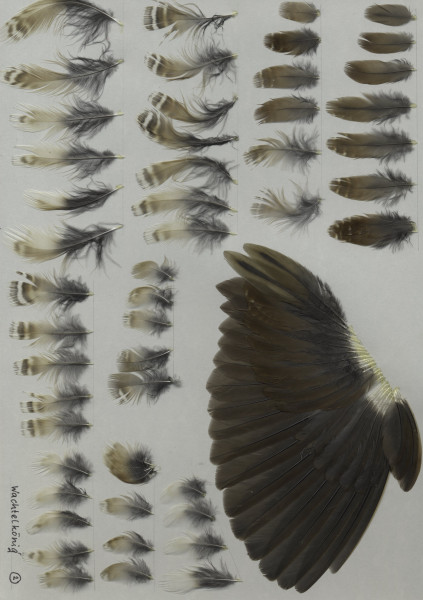
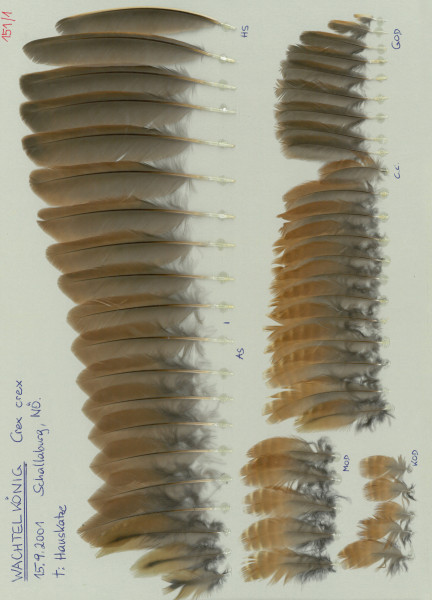
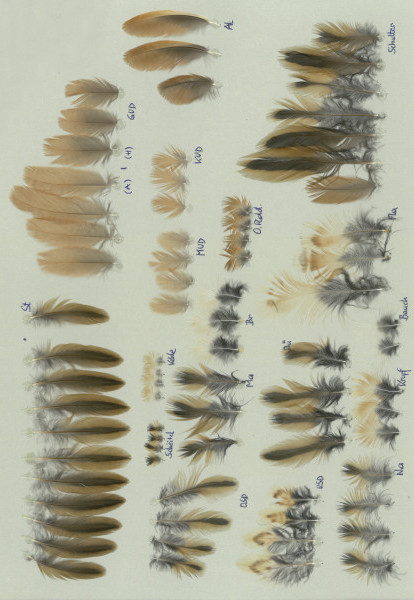
Der Wachtelkönig besitzt ein relativ schlichtes Federkleid. Die Form der Schwingen erinner an andere Rallen wie Teich- oder Blässralle. Einzelne Konturfedern können auch Ähnlichkeiten mit Jagdfasan oder Rebhuhn aufweisen.

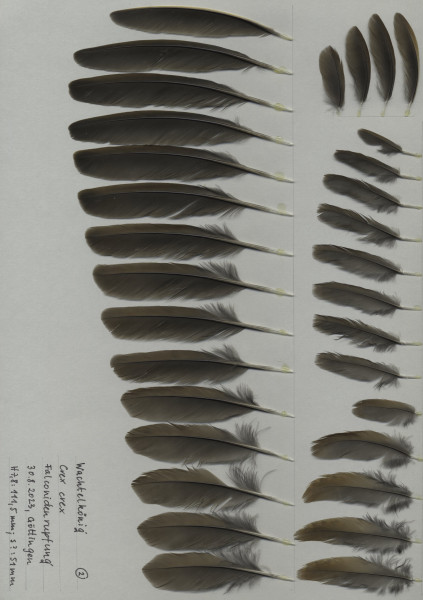
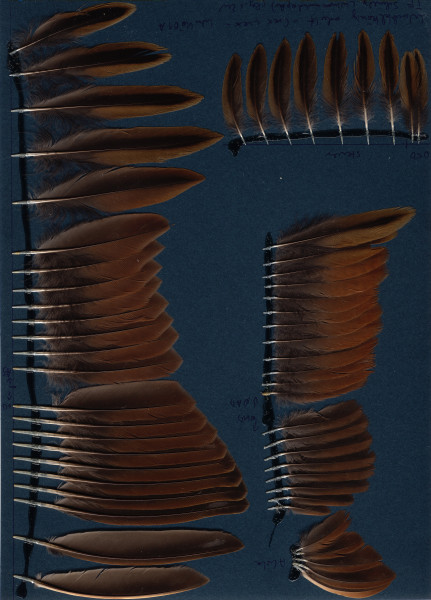
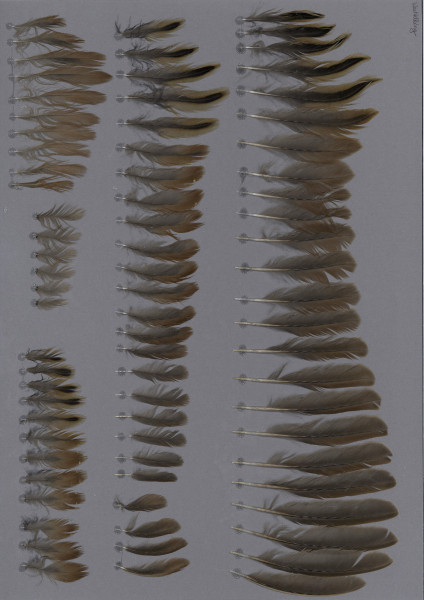
Die Handschwingen sind graubraun, leicht rötlich gefärbt. Die Außenfahne bestitzt ein zimtfarbenes bis rötliches Braun. Der Kiel ist ab den Federstrahlen dunkelgrau bis schwarz. Die längsten Handschwingen (ca. H6-H10 besitzen eine etwas abgedunkelte Spitze.

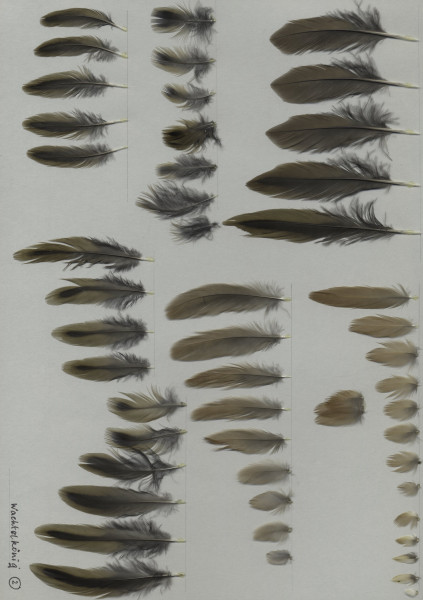
Die Armschwingen sind etwas gleichmäßger gefärbt. Der blasse Rotbraunton findet sich auf beiden Federfahnen. Die Schirmfedern besitzen eine zentrale, gelbbraun gesäumte schwarze Fläche um den Kiel. Die Basis ist gräulicher gesäumt. Auf den GrAd findet sich die selbe Färbung.

Die Steuerfedern sind im Vergleich zu den Schwungfedern relativ klein. Ähnlich den Schirmfedern sind sie rötlich braun mit einer klaren schwarzen zentralen Fläche. Die äußeren Steuerfedern besitzen eine etwas dunklere Innenfahne.

Zu gewissen Ähnlichkeiten im Federkleid kann es innerhalb der Familie mit dem deutlich kleineren Tüpfelsumpfhuhn (Porzana porzana) und der kleineren graubraunen Wasserralle (Rallus aquaticus) kommen.

Pluma Número Más Larga
Primaria 10 Por ala 106.0 - 117.5mm n=6
Primaria8 (83%) Primaria7 (17%)
Secundaria 15 Por ala 98.5 - 105.0mm n=4
Secundaria10 (100%)
Rectriz 12
53.5 - 59.5mm n=3
Rectriz1 (100%)
Anotaciones para los datos de medidas

Número de individuos n

Para las estadísticas de las mediciones de pluma más largas, sólo utilizamos datos de aves que tienen las plumas más grandes presentes. Una pluma rota, perdida o creciente, que podría ser la más larga, descalifica al individuo para la medición. De igual manera, no se incluyen híbridos en las estadísticas, pero aves de diferentes edades (p.ej. gavilanes jóvenes y adultos), sexos (p. ej. gavilanes machos y hembras) y las subespecies se utilizan por igual en el diagrama y, por lo tanto, pueden conducir a una variedad muy amplia de variaciones. Cuanto mayor sea el número de individuos medidos, más precisa será el rango de variación. Los pequeños conjuntos de datos de una o sólo unas pocas aves sólo conducen a resultados aproximados.

Método de medición

The feathers are measured digitally via the scan. A ventral curvature of the feathers is straightened for the measurement, but a caudal curvature is not! Measurements are taken from the start of the calamus to the largest extension of the feather. This does not always have to be the rachis, but can also be the vanes (e.g. in the case of buntings). Special features, such as the wax platelets on the waxwing, are omitted from the measurement.

percentages

The percentages of the individual feathers, e.g. P5, indicate the proportion of individuals in which this feather is the longest of its kind. This information should always be considered in conjunction with the total number of birds measured. An indication of 100% for five individuals is no guarantee that this feather is really always the longest.

Distribución por países

extant

Afghanistan (vagrant) · Albania · Algeria · Angola (vagrant) · Armenia · Austria · Azerbaijan · Bahrain · Belarus · Belgium · Bermuda (vagrant) · Bosnia and Herzegovina · Botswana (vagrant) · Bulgaria · Cameroon (vagrant) · Chad (vagrant) · China · Congo · Congo, The Democratic Republic of the · Côte d'Ivoire (vagrant) · Croatia · Cyprus · Czechia · Denmark · Egypt · Eritrea (vagrant) · Estonia · Eswatini · Ethiopia · Finland · France · Gabon (vagrant) · Georgia · Germany · Ghana (vagrant) · Greece · Greenland (vagrant) · Guinea (origin uncertain) · Hungary · Iceland (vagrant) · Iran, Islamic Republic of · Iraq · Ireland · Israel · Italy · Jordan · Kazakhstan · Kenya · Kuwait · Kyrgyzstan · Latvia · Lebanon · Lesotho (vagrant) · Libya (vagrant) · Liechtenstein · Lithuania · Luxembourg · Malawi · Mali (vagrant) · Mauritania · Moldova, Republic of · Mongolia · Montenegro · Morocco · Mozambique · Namibia (vagrant) · Netherlands · Niger (vagrant) · Nigeria (vagrant) · North Macedonia · Norway · Oman · Palestine, State of · Poland · Portugal · Qatar · Romania · Russian Federation · Rwanda (vagrant) · Saint Pierre and Miquelon (vagrant) · Saudi Arabia · Serbia · Seychelles (vagrant) · Slovakia · Slovenia · Somalia (vagrant) · South Africa · South Sudan · Spain · Sri Lanka · Sudan · Sweden · Switzerland · Syrian Arab Republic · Tajikistan · Tanzania, United Republic of · Tunisia · Türkiye · Turkmenistan · Uganda (vagrant) · Ukraine · United Arab Emirates · United Kingdom of Great Britain and Northern Ireland · Uzbekistan · Viet Nam (vagrant) · Yemen · Zambia · Zimbabwe ·

extinct post-1500

Faroe Islands ·
source: IUCN 2025. IUCN Red List of Threatened Species. Version 2025-1 <www.iucnredlist.org>
assessment data: |

Rails and cranes

Distribución

Estado de conservación

  • CITES
    No incluído en la lista
  • Regulation (EG) Nr. 865/2006
    No incluído en la lista
  • Ley Federal de Conservación de la Naturaleza de Alemania §44
    Estrictamente protegida