


menu

Pallass Fish Eagle
Haliaeetus leucoryphus
species of Accipitridae

ad.

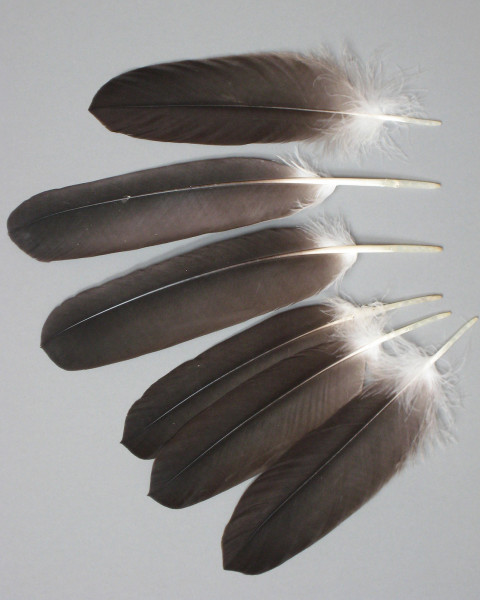
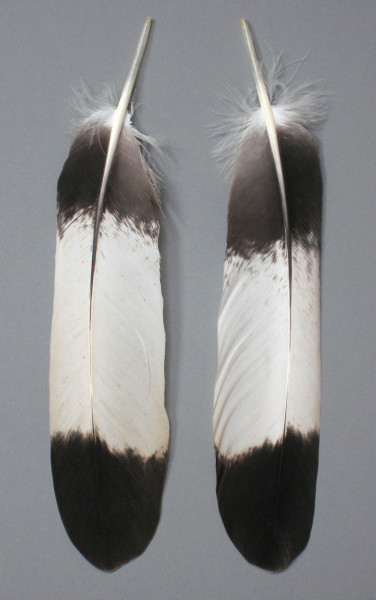
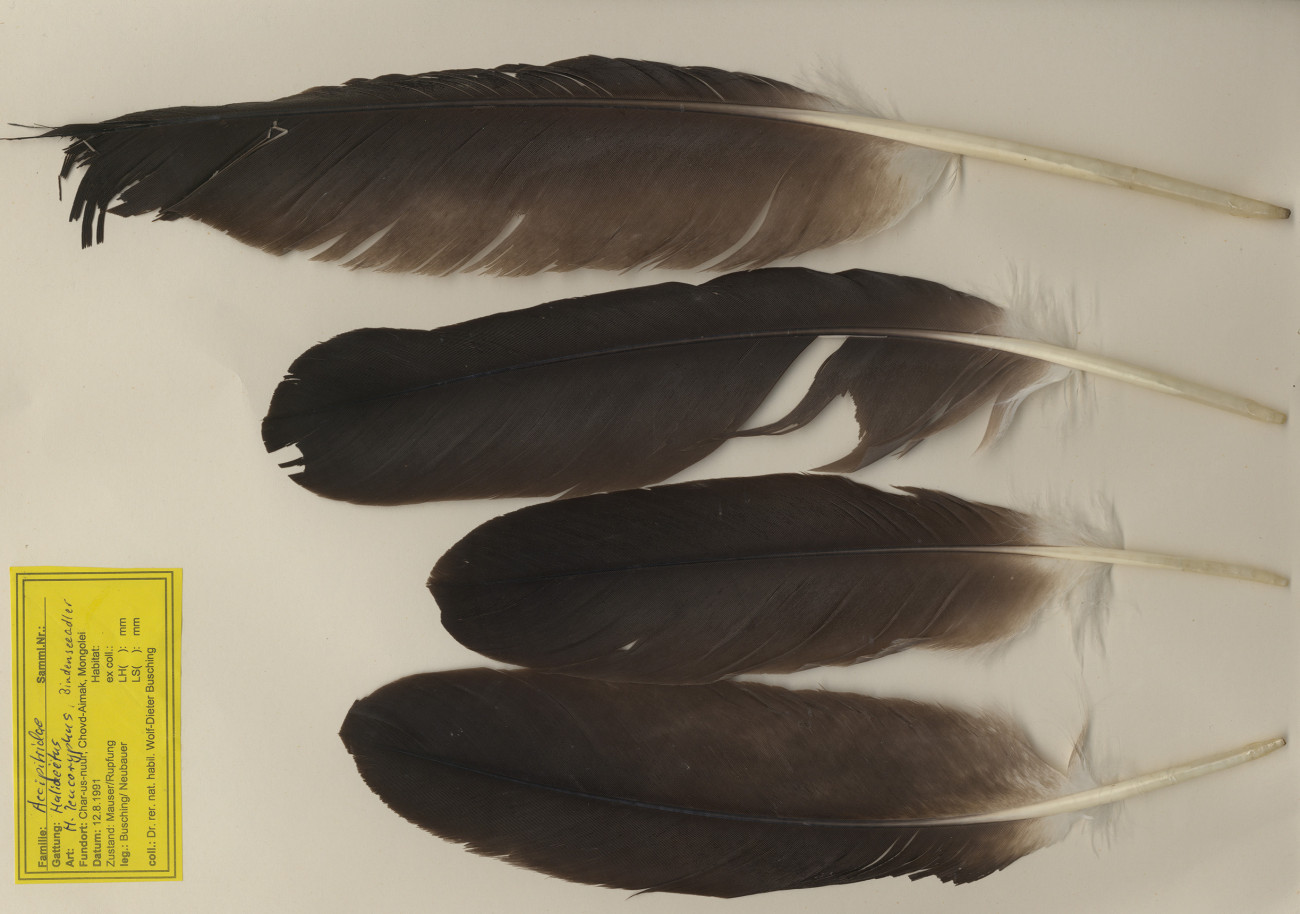
Der Bindenseeadler trägt seinen Namen aufgrund der schwarzen Terminalbinde auf den Steuerfedern. Die Hand- und Armschwingen sind dunkelbraun gefärbt, ähnlich dem Europäischen oder dem Weißkopfseeadler. Die Basis der Federn ist weißlich. Die Steuerfedern sind rein weiß gefräbt. Die Basis besitzt ein graues breites Band, welches nach oben fleckig ausläuft. An der Spitze findet sich eine schwarze Terminalbinde.

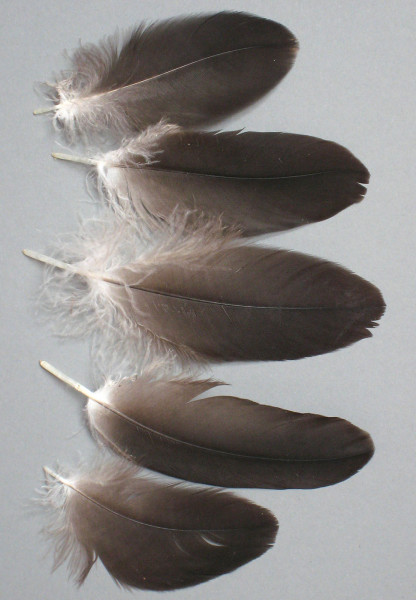
Bei juvenilen Vögeln ist diese Färbung der Steuerfedern noch nicht entwickelt. Sie sind einfarbig braun gefärbt. Die Handschwingen sind auf der Innenfahne fleckig weiß aufgehellt.
wing length1 hand-wing-index1,2 (HWI) primaries-index wing length/longest primary ratio hand-wing-index/primaries-index ratio
552 - 578mm n=5 40 - 45% n=4 no data available no data available no data available
detailed information

The wing length is measured on the flattened and straightened wing ("maximum chord") from the carpal joint to the tip of the longest primary feather, the so-called "Kleinschmidt-method".

combined data from:
Avonet1: 552 - 578mm n=5

The hand-wing-index, introduced by Kipp 1959, is calculated as the ratio of the hand length (difference between the length of the longest primary and the first secondary) to the wing length.

combined data from:
Avonet1: 40 - 45% n=4,
The primaries-index is calculated as the ratio of the longest primary feather length to the first (outermost) secondary. It is the equivalent of the hand-wing index for feather measurements. The wing length/longest primary ratio is calculated as the ratio of the wing length to the length of the longest primary feather. The hand-wing-index/primaries-index ratio is calculated as the ratio of the hand-wing index to the primaries-index.
1 Tobias, J. A., et al. (2022). AVONET: morphological, ecological and geographical data for all birds.
2 Kipp, Friedrich A.: "Der Handflügel-Index als flugbiologisches Maß", erschienen in "Vogelwarte - Zeitschrift für Vogelkunde", 1959, Band 20, Heft 1


country allocations

Hawks, eagles and old world vultures

conservation status

  • CITES
    appendix 2
  • Regulation (EG) Nr. 865/2006
    appendix A
  • German Federal Nature Conservation Act §44
    strictly protected