


menu

Common Crane
Grus grus
species of Gruidae

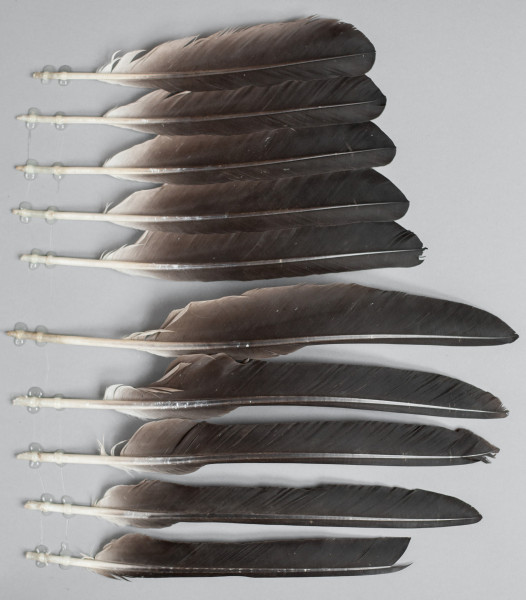
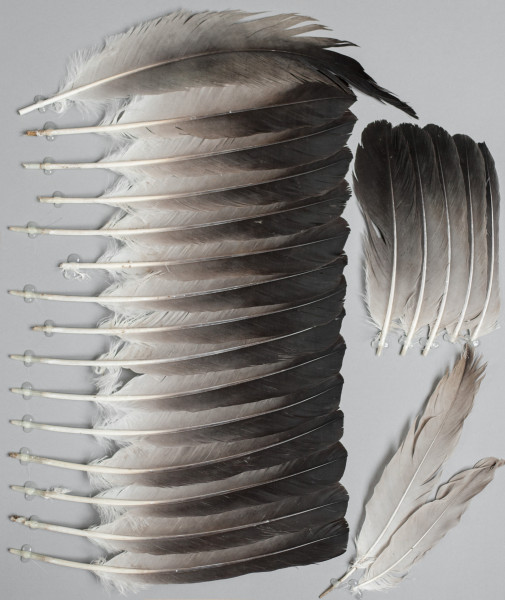
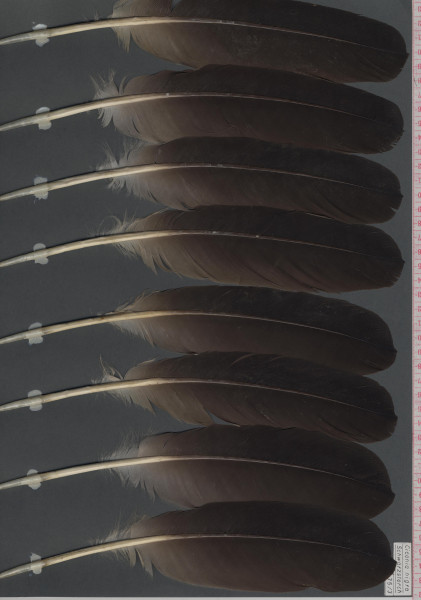
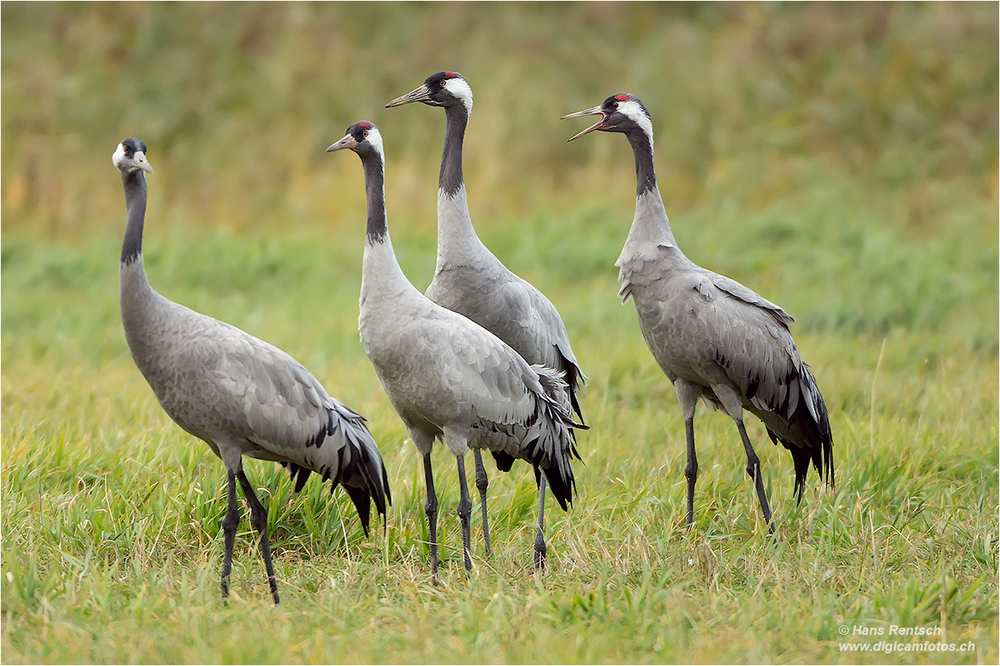
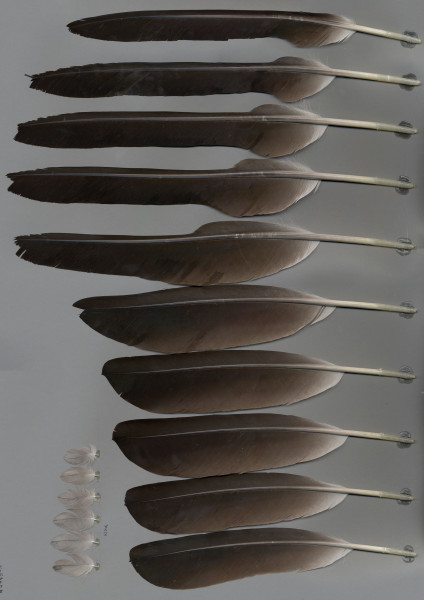
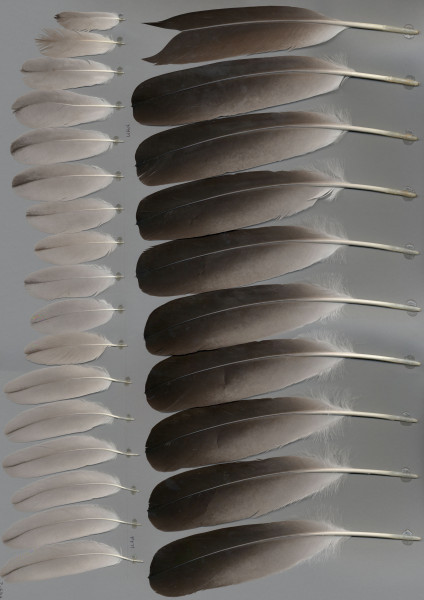
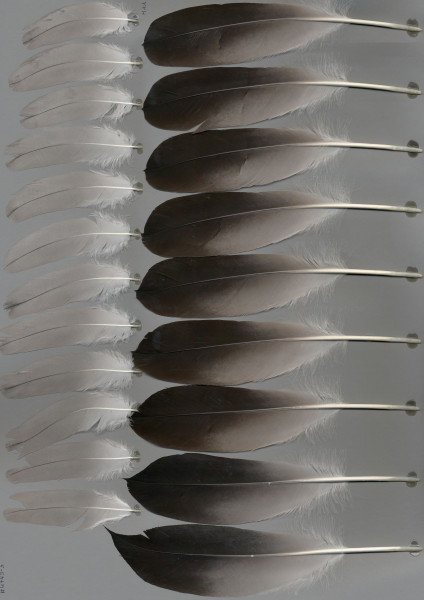
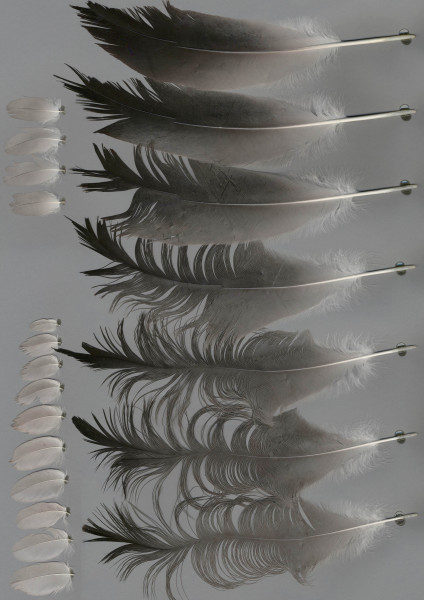
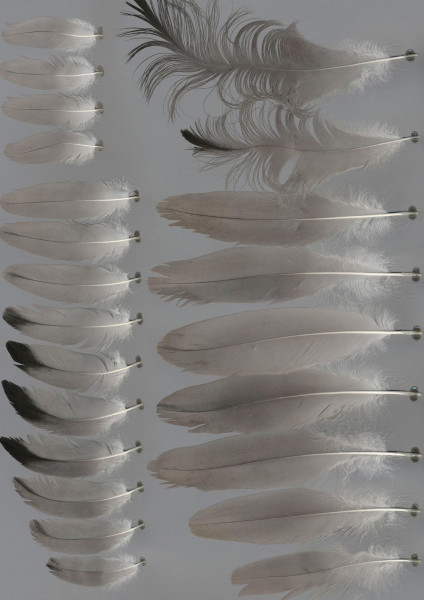
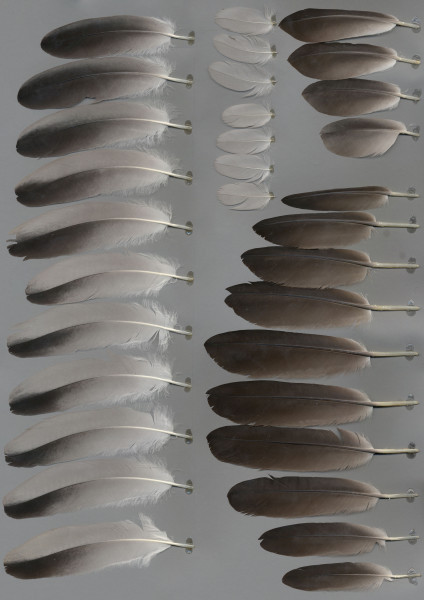
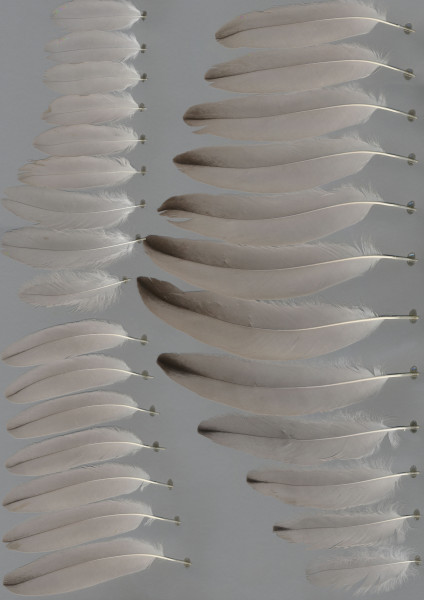
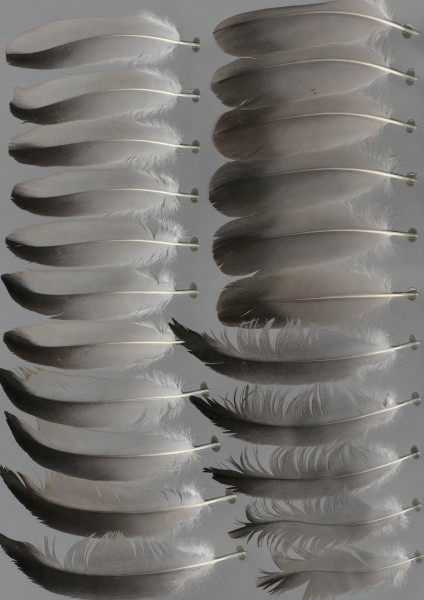
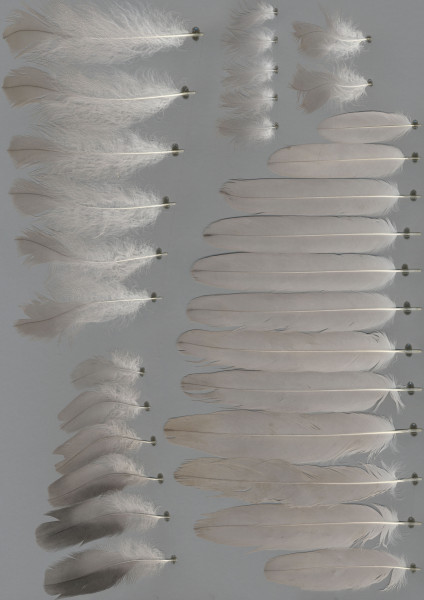
Der Kranich ist in seinem Verbreitungsgebiet relativ eindeutig zu bestimmen. Die Handschwingen sind sehr groß, schwarzgrau mit einer starken, teils weißen Aufhellung der Innenfahnenbasis. Der Kiel ist größtenteils schwarz und breit. Ab der H6 ist die Außenfahne und auch die Innenfahne sehr stark verengt (Stichworte Langstreckenzieher und Gleitflug). Die Verengung als auch die Färbung ist beim Graureiher gänzlich anders. Die Armschwingen sind mittelgrau gefärbt mit einer dunklen Spitze, welche auf der Außenfahne weiter nach unten ragt. Die Schirmfedern sind zu Schmuckfedern umgebildet. Die Federstrahlen dieser Federn besitzen wenig Verästerlungen und haken so nicht untereinander ein. Es ergeben sich zerzaust anmutende Federn auf den Flügeln und am Bürzel des Vogels. Im Herbst lassen sich auf verlassenen Rastplätzen oft gerade diese Schmuckfedern finden.

Die Steuerfedern sind sehr schlicht und klein in Relation zum restlichen Gefieder. Sie sind steingrau gefärbt mit einer fast schwarzen Spitze. Über die Feder zieht sich ein relativ gleichmäßiger Farbverlauf.

Der Schwarzstorch (Ciconia nigra) ist dem Kranich im Gefieder noch am ähnlichsten. Dieser besitzt jedoch 11 statt nur 10 Handschwingen und ist deutlich gleichmäßiger schwarz gefärbt ohne große Farbverläufe oder Säume. Ebenfalls findet sich beim Schwarzstorch ein metallischer Glanz auf den Federn.

number longest
primary 10 per wing 469.0 - 479.0mm n=2
P7 (100%)
secondary 30 per wing approx. 419.5mm n=1
S21 (100%)
retrix 12
approx. 240.0mm n=1
R3 (100%)
wing length1 hand-wing-index1,2 (HWI) primaries-index wing length/longest primary ratio hand-wing-index/primaries-index ratio
492 - 600mm n=5 39 - 47% n=4 no data available no data available no data available
detailed information

The wing length is measured on the flattened and straightened wing ("maximum chord") from the carpal joint to the tip of the longest primary feather, the so-called "Kleinschmidt-method".

combined data from:
Avonet1: 492 - 600mm n=5

The hand-wing-index, introduced by Kipp 1959, is calculated as the ratio of the hand length (difference between the length of the longest primary and the first secondary) to the wing length.

combined data from:
Avonet1: 39 - 47% n=4,
The primaries-index is calculated as the ratio of the longest primary feather length to the first (outermost) secondary. It is the equivalent of the hand-wing index for feather measurements. The wing length/longest primary ratio is calculated as the ratio of the wing length to the length of the longest primary feather. The hand-wing-index/primaries-index ratio is calculated as the ratio of the hand-wing index to the primaries-index.
1 Tobias, J. A., et al. (2022). AVONET: morphological, ecological and geographical data for all birds.
2 Kipp, Friedrich A.: "Der Handflügel-Index als flugbiologisches Maß", erschienen in "Vogelwarte - Zeitschrift für Vogelkunde", 1959, Band 20, Heft 1


country allocations

extant

Afghanistan · Albania · Algeria · Armenia · Azerbaijan · Bahrain · Bangladesh · Belarus · Belgium · Bhutan · Bosnia and Herzegovina · Bulgaria · Canada (vagrant) · China · Croatia · Cyprus · Czechia · Denmark · Djibouti (vagrant) · Egypt · Eritrea · Estonia · Ethiopia · Faroe Islands (vagrant) · Finland · France · Georgia · Germany · Gibraltar (vagrant) · Greece · Hong Kong (vagrant) · Hungary · Iceland (vagrant) · India · Iran, Islamic Republic of · Iraq · Ireland (vagrant) · Israel · Italy · Japan · Jordan · Kazakhstan · Korea, Democratic People's Republic of · Korea, Republic of · Kuwait (vagrant) · Kyrgyzstan · Lao People's Democratic Republic · Latvia · Lebanon · Libya · Liechtenstein (vagrant) · Lithuania · Luxembourg · Malta · Mauritania (vagrant) · Moldova, Republic of · Mongolia · Montenegro · Morocco · Myanmar · Nepal · Netherlands · Niger (vagrant) · Nigeria (vagrant) · North Macedonia · Norway · Oman · Pakistan · Palestine, State of · Poland · Portugal · Qatar (vagrant) · Romania · Russian Federation · Saudi Arabia · Serbia · Slovakia · Slovenia · Spain · Sudan · Svalbard and Jan Mayen (vagrant) · Sweden · Switzerland · Syrian Arab Republic · Tajikistan · Tunisia · Türkiye · Turkmenistan · Ukraine · United Arab Emirates (vagrant) · United Kingdom of Great Britain and Northern Ireland · United States of America (vagrant) · Uzbekistan · Viet Nam · Yemen ·

extinct post-1500

Austria ·
source: IUCN 2025. IUCN Red List of Threatened Species. Version 2025-1 <www.iucnredlist.org>
assessment data: |

Rails and cranes

distribution

conservation status

  • CITES
    appendix 2
  • Regulation (EG) Nr. 865/2006
    appendix A
  • German Federal Nature Conservation Act §44
    strictly protected